<< collection 18 | collection 20 >>

<< previous page | next page >>


19. DICTIONARIES & LEXICAL TEXTS

MS 3173 Sumer, ca. 3100-3000 BC
See also MS 2429/4, Sumer, 3100-3000 BC
See also MS 2340, Sumer, 26th c. BC

MS 2462 Sumer, ca. 2500 BC

MS 3178 Babylonia, 1400-1100 BC
See also MS 189, Egypt, 1st c. BC
See also MS 1816, Germany, ca. 800

MS 1777 Northern France, Flanders or England, 1150-1175

MS 2195 Egypt, 13th c.
See also MS 2547, China, 1307-1367

MS 1000 Italy, ca. 1400
MS 5267 Ireland, 1795
MS 2614 China, 1814

19. Dictionaries & Lexical Texts
MS 3173  
LEXICAL LIST OF TREES, WOODEN OBJECTS, GEOGRAPHICAL NAMES AND TYPES OF SPADES MS 3173

MS in Sumerian on clay, Sumer, Uruk III, 3100-3000 BC, lower 1/2 of a tablet, 10,5x24,5x4,5 cm (originally ca. 25x24,5x4,5 cm), 9 columns, 120 lines in pictographic script.

Commentary: This is by far the largest pictographic tablet known. It represents a new lexical tradition different from the 13 Uruk lists of titles (MS 2429/4), animals, fish, plants, jars, cities, etc. The present list would have had no less than 230 geographical names compared to the Uruk city list of 88 entries. The later Tell Abu Salabikh (ca. 2500 BC) and Ebla (ca. 2400 BC) lists had 289 entries, but entirely different from the present one.

back to top top
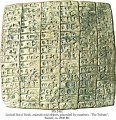
MS 2462 MS 2462
LEXICAL LIST OF BIRDS, ANIMALS AND OBJECTS, PRECEDED BY NUMBERS, "THE TRIBUTE"


MS in Sumerian on clay, Sumer, ca. 2500 BC, 1 tablet, 12,6x13,4x2,5 cm, 6 columns, 96 compartments in a fine professional cuneiform script.

Binding: Barking, Essex, 1998, blue quarter morocco gilt folding case by Aquarius.

Commentary: "The Tribute" dates to ca. 2900 BC; the present tablet is an Early Dynastic version of the text, the only one so far attested.

back to top top
MS 3178  
LEXICAL SERIES "EA A NÂQU", TABLET 7, GIVING FIRST THE SUMERIAN PRONUNCIATION OF A SIGN, THEN THE SUMERIAN SIGN ITSELF, AND THEN THE BABYLONIAN TRANSLATION OF IT

MS in Neo Sumerian and Babylonian on clay, Babylonia, 1400-1100 BC, 1 tablet, 24,3x16,5x4,0 cm, 2+2 columns, 213 lines of originally ca. 260 lines, in cuneiform script.

Context: Another tablet from "ea A nâqu" is MS 1811. The lexical series "ea A nâqu" consists of 8 tablets. From tablet 7 only 98 lines have so far been known of a total of ca. 260 lines. With the present tablet nearly all of the 260 lines can be restored.

Commentary: This series and the series "Aa A nâqu" of 42 tablets are the basic tool and the foundation for reading and understanding the Sumerian and Babylonian languages. The present tablet fills a major gap in that knowledge. This is one of a very few witnesses from the Middle Babylonian period.

See also MS 189, School Text or Dictionary, explaining verbs of motion. Egypt, 1st c. BC

See also MS 1816 Isidorus Hispalensis: Etymologiarum sive originum, lib. XI, ii:33-37. Germany, ca. 800

MS 3178
back to top top
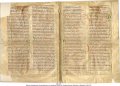
MS 1777 MS 1777

ISIDORUS HISPALENSIS: ETYMOLOGIARUM SIVE ORIGINUM, BOOK 20, WITH LIST OF CHAPTERS

MS in Latin on vellum, Northern France, Flanders or England, 1150-1175, 2 ff., 39x29 cm, 2 columns, (31x22 cm), 44 lines in Romanesque book script of medium quality, over 150 small painted capitals in red or green, 9 large 2-line decorated initials in red or green.

Provenance: 1. Cistercian Abbey of Cercamp, Diocese of Amiens, Arras, France; 2. André Simon collection, France(?); 3. Sotheby's 6.12.1993:5.

Commentary: St. Isodore of Sevilla (560-636) seems to have worked until the end of his life on this great encyclopaedia. Even then the vast work was not finished, and Bishop Branlio of Saragossa made the final editing and the division into 20 books. The earliest MSS are from Spain, France and England, all 8th c. For the earliest German witness, ca. 800, see MS 1816. From then on this central medieval text spread very swiftly through all of Europe.

back to top top
MS 2195
TANHUM BEN JOSEPH YERUSHALMI: THE ADEQUATE GUIDE, AN ALPHABETICAL CONCORDANCE TO THE MISHNEH TORAH OF MAIMONIDES

MS in Hebrew and Judaeo-Arabic on paper, Egypt, 13th c., 38 ff., 20x13 cm, single column, (14x9 cm), 18 lines in an oriental rabbinic Hebrew cursive script.

Binding: England, 1900-1940, dark red morocco gilt, sewn on 5 cords.

Context: Another MS of the same author and Maimonides is MS 1862.

Provenance: 1. The Cairo Genizah, Fustât, Egypt (-ca. 1896); 2. David Solomon Sassoon's Library, Hertfordshire, MS.410 (ca. 1921-1942); 3. David Solomon Sassoon's trustees (1942-1994); 4. Sotheby's 21.6.1994:86 (5th Sassoon sale); 5. Sotheby's 18.6.1996:42.

MS 2195

Commentary: This MS is contemporary with the author, Tanhum ben Joseph Yerushalmi (ca. 1220-1291). Second to the caves of the Dead Sea Scrolls, the great Genizah in Cairo is the most significant and evocative source for any fragments of early Hebrew MSS. The Genizah was fully unearthed from 1896. Probably no Egyptian finds, except that of Tutankhamon in 1922, has ever excited the public imagination so much at the time of the discovery. No single source have added so much to our knowledge of early Jewish culture. Literature: D.S. Sassoon: Ohel Dawid, Descriptive Catalogue of the Hebrew and Samaritan Manuscripts in the Sassoon Library, London 1932, I, p. 492.

Exhibited: XVI Congress of the International Organization for the study of the Old Testament. Faculty of Law Library, University of Oslo, 29 July - 7 August 1998.

See also MS 2547, Encyclopaedia of the writing styles and formats. China, 1307-1367. 13 vols.

back to top top
MS 1000  
THE PLINY OF SAINT JAMES IN THE MARCH
GAIUS PLINIUS SECUNDUS MAIOR: HISTORIA NATURALIS BOOKS 1-13, 19-37
 

MS in Latin on vellum, Italy, ca. 1400, 2 vols., 105+177 ff. (complete), vol. 1 (Books 1-13): 35x25 cm, single column, (25x16 cm), 44-59 lines in Italian cursive by several scribes, vol. 2 (Books 19-37): 37x25 cm, 2 columns, (25x16 cm), 43-45 lines in a clear Gothic book script, several large fine decorated initials in blue with red penwork and marginal extenders, numerous smaller initials in red or blue with marginal scrollwork, contemporary annotations by Saint Giacomo della Marca, including autograph notes at the end of each volume, signed by Saint Giacomo.

Binding: England, 19th c., blindtooled brown diced russia, sewn on 5 bands.

Context: MSS owned by saints: MSS 260/36, 620, 639, 1000 and 1751.

Provenance: 1. Saint Giacomo della Marca, Monteprandone in the March of Ancona (1394-1476); 2. Franciscan Convent of Santa Maria delle Grazie, Monteprandone in the March of Ancona (15th-early 19th c.); 3. Thomas Payne, London (1823); 4. Sir Thomas Phillipps, Cheltenham, Ph 4196-97 (1823-1872); 5. Harrison D. Horblit, Ridgefield, Connecticut (d. 1988); 6. H.P. Kraus cat. 155(1980):14, and cat. 186(1991):126.

MS 1000

Commentary: From a Saint's library, with his autograph annotations and signatures. On the endleaves of both volumes, the Franciscan Saint Giacomo della Marca (St. James in the March) writes that he bought both volumes together for 14 1/2 gold ducats for the convent, and ends with: "ego frater Jacobus de eodem loco". He was observantine friar, a pupil of St. Bernardinus of Siena, mendicant preacher, penitent, scribe and inquisitor.

Pliny (23-79) was a man so intensely interested in the natural world that he was killed while trying to observe at close quarter the eruption of Vesuvius, that buried Pompeii, Herculaneum and Stabia.

Pliny the younger claimed that his uncle's book in 37 volumes was "a learned and comprehensive work as full of variety as nature itself". It includes more than 20,000 facts derived from over 2000 earlier texts, which makes it much more than the title implies. It is an encyclopaedia of all the useful knowledge of the ancient world, covering astronomy, geography, zoology, botany, agriculture, medicine, magic, mining and minerals, coinage, painting, sculpture, papyrus making, scribal techniques, architecture, anthropology, philosophy, history, and more.

back to top top

MS 5267

 
  1. COLONEL VALLANCEY: IRISH DICTIONARY
  2. SIR THOMAS PHILLIPPS: ACQUISITION LIST OF MANUSCRIPTS AND PRINTED BOOKS, 1860-1866

MS in Irish, English, French, Latin, Hebrew, Greek, Arabic (text 1), and English, French, German, Italian, Latin, Greek (text 2) on paper, text 1: Dublin, 1795, 43 pp.; text 2: Middle Hill, 1860-1866, 288 pp.; 32x19 cm, single column, (30x18 cm), in cursive script by Colonel Vallancey (text 1) and Sir Thomas Phillipps (text 2), as a ledger with alphabet tabs.

Binding: Dublin, 18th c., calf-backed marbled boards, sewn on 5 cords.

Provenance: 1. B. Dugdale, bookseller and stationer, Dublin (18th c.); 2. Colonel Vallancey, Dublin (18th c.); 3. Sir Thomas Phillipps, Cheltenham, MS 15948 (1860-1872); 4. Katharine, John, Thomas & Alan Fenwick, Cheltenham (1872-1946); 5. Robinson Bros., London (1946-1978); 6. H.P. Kraus, New York (1978-1991).

Commentary: Sir Thomas Phillipps used the blank pages to list thousands of MSS and printed books as he acquired them. At a later date he added the corresponding numbers of his printed catalogue. The acquisition list starts with the present MS. Text 1 is an alphabetical dictionary of Ireland's geographical names with their location, origin and meaning.

  MS 5267 MS 5267
back to top top

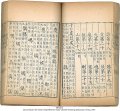
MS 2614

 
JIYUN BUKAN; THE MOST COMPREHENSIVE EARLY CHINESE RHYMING DICTIONARY, CONTAINING NO LESS THAN 53,525 CHARACTERS, ARRANGED BY THE SYSTEM OF FINAL SOUNDS. COMPILED BY DING DU AND OTHERS MS 2614

Blockprint and MS in Chinese on paper, Nanjing?, China, 1814, 5 vols., 23x14 cm, 8 columns, (16x11 cm), 16 characters in Chinese book script, additions in black and red ink; MS: 4 pp. owner's notes (16x10 cm) 12 columns, 20 characters; titles on bottom edges. Binding: Nanjing?, China, 1814, stitched on 4 stations (xiangzhuang), grey paper covers.

Provenance: 1. Scholar collector, China (1842): 2. Fan Xiangyong, China (1957); 3. Ekky Chung collection, Indonesia/Beverly Hills, California (-1997?); 4. Sam Fogg Rare Books Ltd.

Commentary: This dictionary was compiled by imperial order in 1034. It probably took some years to complete the work, and possibly additional editorial changes were made before it was published. It was printed by copper movable type. These types, in the Qing dynasty, were often engraved by hand instead of cast into molds. The preface says that the copier was Gu Guangqi, and the engravers, from Nanjing, were 3 brothers, Liu Wenkuei, Liu Wenkai and Liu Wenmo. This work had been in the collections of several scholars who either commented on the history of Jiyun bukan or corrected the misprints in red ink throughout this edition. Concluding from their opinions, this edition was copied after the woodblock edition by Chao Dongting published in Kangxi reign (1662-1722), and was proved according to a manuscript copy of a Song edition by Ruoying. They also provide information about the original Song edition including its format, content and whereabouts. Two such comments are dated, one was written at the 22nd year (1842) of Daoguang reign and one in 1957 by Fan Xiangyong.

back to top top

>> CHINA