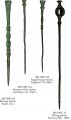
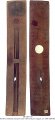
This collection covers all aspects of scribal activity, job descriptions, signed colophons, scribal illustrations, and equipment such as reeds, styli, inkwells and wax tablets.
It also includes a series of ancient school texts, taking the student through all stages from learning writing and grammar, to exercises in literature and advanced mathematics.
| MS 2429/4 | ![]() |
| LEXICAL LIST OF 41 TITLES AND PROFESSIONS, STARTING: NAM GIS SITA=LORD OF THE MACE. SIGNED BY THE SCRIBE GAR.AMA; SCHOOL TEXT | |
MS in archaic Sumerian on clay, Sumer, 31st c. BC, 1 tablet, 8,6x8,0x1,7 cm, 5 columns, 41+1 compartments in pictographic script by the scribe GAR.AMA. Commentary: Lord of the mace is an early Sumerian term for king or ruler. The pictographic lexical lists are the earliest such literature known; and also the earliest known evidence of school and learning. The scribes signatures on the present MS and other lexical lists are the earliest autograph signatures extant. Exhibited: Oslo Katedralskole 850 år, Jubileumsutstilling 10. - 14. March 2003. See also MS 3047, Mathematical exercise, Sumer, 27th c. BC |
top
| MS 4481 | |
TSCHOOLDAYS A: GRADUATE OF THE SCRIBAL ACADEMY, WHERE DID YOU GO IN OLDEN DAYS? I WENT TO SCHOOL, WHAT DID YOU DO IN SCHOOL? I READ MY TABLET, AND COPIED MY TABLET. THEY PREPARED FOR ME MY PREPARED LINES - LET ME TELL YOU WHAT MY TEACHER TOLD ME - EVEN A FOOL COULD EASILY FOLLOW HIS INSTRUCTIONS, TABLETS OF SUMERIAN AND AKKADIAN, TABLETS OF THE SCRIBAL ART - I AM SCRIBE AND KNOW HOW TO INSCRIBE A STELA. COLOPHON: NISABA (GODDESS OF WRITING). TOTAL: 36 LINES, EXERCISE TABLET. SUEN -USELLI RECEIVED IT ON 22ND DAY OF MONTH 11 |
![]() |
MS in Neo Sumerian on clay, Babylonia, ca. 19th c. BC, 1 tablet, 10,9x6,0x2,9 cm, single column, 39+6 lines in cuneiform script. See also MS
2367/1, Literature exercise, Babylonia, 20th-17th c. BC |
top
![]() |
|
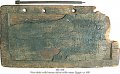
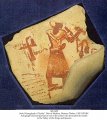
| SESH, HIEROGLYPH OF "SCRIBE", CONSISTING OF THE PALETTE WITH WELLS FOR RED AND BLACK INK, SHOULDER STRAP, WATER POT AND REED PEN | |
MS in Egyptian on limestone flake, Deir-el-Medina, Western Thebes, Egypt,
19th or 20th dynasty, 1292-1069 BC,
1 ostracon, 11x12 cm,
with the hieroglyph "sesh" in an expert script, sketch in rust-red of the
standing scribe wearing a knee-length kilt, his arms raised to present a
papyrus scroll and possibly a writing palette, behind him an offering-table. Binding: Barking, Essex, 1993, red cloth gilt folding case, by Aquarius. |
|
Provenance: 1. Excavated at Deir-el-Medina, Western Thebes (ca. 1975); 2. Bernard Quaritch Ltd., London. Commentary: Deir-el-Medina is the village which was occupied by the community of workmen employed on constructing and decorating the tombs in the Valley of the Kings and Valley of the Queens. Many such pieces, mostly dating from the 19th and 20th Dynasties (1292-1069 BC), have been recovered from this site, mainly being detailed drafts for specific details of a tomb's decoration. This piece is unusual, showing not only the scribe's autograph, but also his self-portrait. Exhibited: Conference of European National Librarians, Oslo. Sept. 1994. See also MS 4575, Medical text, Uruk, ca. 300 BC |
|
top
| MS 1985 | |
|
|
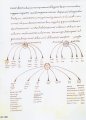
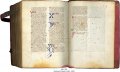
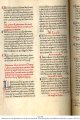
MS in Catalan on paper and vellum, Aragon, Spain, 1412-1416, 169+5 ff. (text complete), 34x23 cm, 2 columns, (21x15 cm), 38 lines in a rotunda Gothic book script of medium quality, titles in Gothic book script of high grade and very good quality, by the scribe Salvius Calsada, rubrics in red, large, up to 16-line, initials alternately in red and blue with contrasting penwork in purple and red with full marginal flourishes.
Binding: Spain, 18th c., gilt calf, sewn of 6 bands, gilt edges, red morocco spine label gilt. Context: The text is recorded in 7 MSS. 3 are in Paris: Bibliothèque Nationale de France, 1 in Wien: Reichsarchiv. |
![]() |
Provenance: 1. Gralta Family, Treasurers of Catalonia (ca. 1412-1416 -); 2. Marquess of Aitona, treasurer of Catalonia; 3. Frederick North, 5th Earl of Guilford (-1827); 4. R.H. Evans, London 8.12.1830; 5. Sir Thomas Phillipps, Cheltenham, Ph 6737, (1830-1872); 6. Katharine, John, Thomas & Alan Fenwick, Cheltenham, (1872-1946); 6. Robinson Bros., London (1946-1969); 8. Sotheby's 25.11.1969:464; 9. Joan Gili, Oxford (1969-1994); 10. Jeremy Griffiths, Oxford. Commentary: The present text describes in extraordinary detail the organisation of a medieval Court under the different departments of the household, ranging from butler, cooks, and provisioners to the falconers, doctors, mace-bearers and keepers of the horses, with full descriptions of their jobs and their responsibilities. A considerable part of the MS concerns the work of the scribes of the various departments, such as copying documents, taking letters, keeping accounts, copying instructions, sealing, preparing vellum, ink and pens, in all ca. 40 different scribal jobs. The present text is a major source to the knowledge of the medieval scribe. Exhibited: University of Oslo. Domus Bibliotheca, 6-15 May 1996: European medieval manuscripts from The Schøyen Collection. See also MS 1793, Scribe at work, Russia, 1550-1560 |
|
top
top
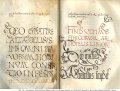
| MS 111 | |
|
![]() |
| MS in Latin on vellum, Napoli, Italy (or perhaps Catalonia, Spain), ca. 1458-1459, 188 ff. (ff. 4-6 later additions), else complete, 30x22 cm, single column, (18x12 cm), 25-28 lines in a strong humanistic book script with many calligraphic flourishes by the Spanish scribe Gabriel Altadell, incipits and explicits in red for all books and prefaces, except two, running headings and capitals in red, 114 3-&4-line initials in burnished gold, 1 3-line painted | |
| initial in red, 17 large initials in burnished gold with full and
partial border decoration of elaborate white-vine scrolls against blue, green,
red and burnished gold grounds, filled with putti, monkeys, dogs, dragons,
hybrid beasts and exotic birds, some with burnished gold dots surrounded with
black penwork, by one of the artists who worked on the Hours of King Alfonso.
Arms of the Copons family of Catalonia on f. 9r.
Binding: Spain, ca. 1900, vellum over board, sewn on 3 thongs, with gilt floral border, inlaid in centre of the upper cover a calf panel from the former binding with a wreath ornament gilt, on the lower cover a gilt monogram MB. |
![]() |
|
Context: 7 other MSS signed by the same scribe are known. Provenance: 1. The Copons family, Catalonia (from 1458/59); 2. Marques of Barbara, Barcelona (until 1968); 3. William H. Schab, New York, Cat. 46(1968):1; 4. Commodore Tammaro de Marinis, Firenze (from 1968); 5. Bruce Ferrini, Akron, Ohio, Cat. 2(1989):4. Commentary: 3 half- and full-page colophons, on ff. 8, 160 and 171, in humanistic capitals, Gothic book script and Greek capitals, with extensive, elegant and exaggerated flourishes. All signed by Altadell, who is known for showing off his abilities as a scribe. Aristoteles’ (384-322 BC) Ethika was dedicated to his son Nichomachus, while his other work on ethics is known as the Eudemian Ethics. They cover much the same topics, instructions how to achieve happiness and human virtues by intellectual activity, as well as by moral intention and virtue of character. Exhibited: University of Oslo. Domus Bibliotheca, 6-15 May 1996: European medieval manuscripts from The Schøyen Collection. |
|
![]() |
For further scribal colophons see:
MS 2226,
Assyria, 705-681 BC |
|
|
top